The Power Limit Club: An Evening Among Britain’s Five-Watt Optimists
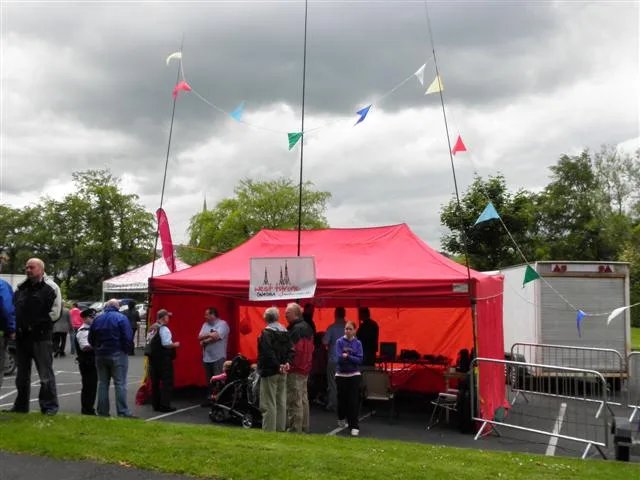
Photo: Kenneth Allen , CC BY-SA 2.0, via Wikimedia Commons
There is a particular sound to a club night where nobody is allowed to switch on an amplifier. It is not silence, exactly. It is the rustle of people leaning over a rig, the scratch of a pencil on a log sheet, and the occasional mutter of “is that a bit of a match?” as somebody tries to persuade a coil of wire that it is, in fact, an aerial. At a village hall somewhere in the Midlands, the Five Watts and a Wet String night is underway, and the room is full.
The Rules Are Simple, Which Is the Point
The format has been picking up pace across UK clubs in 2026. The idea is straightforward: no linear amplifiers, no walloping great beams if you can avoid them, and a strict power ceiling of five watts. Some clubs allow 10 watts for 2m and 70cm; others stick rigidly to five across the board. The aerial must be homemade, or at least home-adapted. A length of wire, a fishing pole, a few metres of coax and a healthy sense of optimism are all permitted.
What is not permitted is the usual arms race. There is no “just turning it up a notch” when the contact is tricky. There is no comparing the price of a linear. Instead, there is a table of biscuit tins, a shared kettle, and a rota of people waiting to use the club’s one decent ATU.
“We started it because the contest nights were getting a bit quiet socially,” says Janet, the club’s events secretary, who is wearing a fleece with a faded callsign embroidered on the chest. “People would come in, put the headphones on, and disappear for three hours. This is the opposite. You can hear everybody thinking.”
The Aerial Is the Star
On this particular evening, the aerials are the main topic of conversation. One member has brought a vertical made from an old fibreglass fishing rod and a choke fashioned from a spare toroid. Another has a dipole strung between two gazebo poles, with the centre supported by what appears to be a walking stick. A third has gone for a magnetic loop built into a hula hoop, which is either ingenious or deeply suspicious depending on which side of the room you stand.
The club sets up two operating positions: one for HF, one for VHF. The HF rig is an elderly but beloved Icom, set to five watts and connected to a wire that has been cut, soldered and re-cut twice already. The VHF position uses a slim Jim made from 300-ohm ribbon, hanging from a hook normally reserved for the hall’s Christmas decorations.
“The first time we did it, I thought we’d get nowhere,” admits Martin, a Foundation licence holder who has been licensed for just over a year. “I’d only ever used the club’s big rig on field day. Here I was, five watts, wire in a tree, and I worked a station in the Netherlands. I think I said ‘really?’ about four times.”
Surprising Contacts, Modest Distances
The contacts are not the stuff of DXCC legends, and that is part of the charm. On this night, the club works a handful of stations across England, one in Wales, and a surprisingly clear contact into a French department whose name nobody can spell without checking. There is a brief pile-up on 40m when a special event station comes up, but the five-watt crowd does not pile up so much as form an orderly queue with occasional apologies.
What is striking is how much the operators learn from the limitations. With five watts, aerial efficiency matters. Feedline losses matter. Grounding matters. The angle of the wire, the height of the pole, the length of the counterpoise — all of it becomes visible in a way that a 400-watt linear can happily paper over. Newer licence holders quickly discover that the difference between a mediocre aerial and a decent one is not a matter of opinion; it is a matter of whether the other station can hear you at all.
“You can explain impedance matching until you’re blue in the face,” says Janet. “But when somebody moves their wire six feet and suddenly gets a report, it clicks. That’s the night doing its job.”
Skills, Not Scores
The club does not keep a league table. There is no prize for the furthest contact, although there is a small, much-coveted wooden spoon for the most ambitious aerial failure. Instead, the evening ends with a quick round of “what worked and what didn’t”, which is usually more useful than any contest score.
For newer licence holders, the format is a gentle introduction to operating under pressure — but the pressure is mostly self-imposed. You cannot hide behind power, so you learn to listen properly, to call at the right time, and to accept that sometimes the band is just not playing ball. You also learn that a homemade aerial is not a compromise; it is a skill.
For the more experienced members, it is a reminder of why they got into the hobby in the first place. There is something deeply satisfying about coaxing a contact out of a piece of wire and a five-watt signal, especially when the station at the other end sounds genuinely pleased to hear you.
The Sociable Side of Restriction
Perhaps the most unexpected result is how social the night has become. With no amplifier to tweak and no contest score to chase, people wander between the operating positions. They compare notes on baluns. They drink tea. They help a new member solder a connector. The clubroom feels less like a radio shack and more like a workshop with a shared purpose.
“We’ve had people join because of this night,” says Martin. “They hear about it and think, ‘I haven’t got a big rig, but I’ve got a bit of wire and a licence.’ That’s a much lower barrier than a contest.”
As the evening winds down, the aerials are taken apart and the kettle is drained. The log sheet shows a modest number of contacts, none of them earth-shattering. But the room is still buzzing. Five watts, it turns out, is plenty — as long as you have a wet string, a decent crowd, and a willingness to learn.